Published November 26, 2025 10:34AM
This Tiny Tweak Made Atomic’s Stiffest Boot Skiable for Us Mere Mortals
Inside Atomic’s Austrian factory, engineers rethought the Redster’s famously tight fit and discovered that a few millimeters in the toe box could change everything.
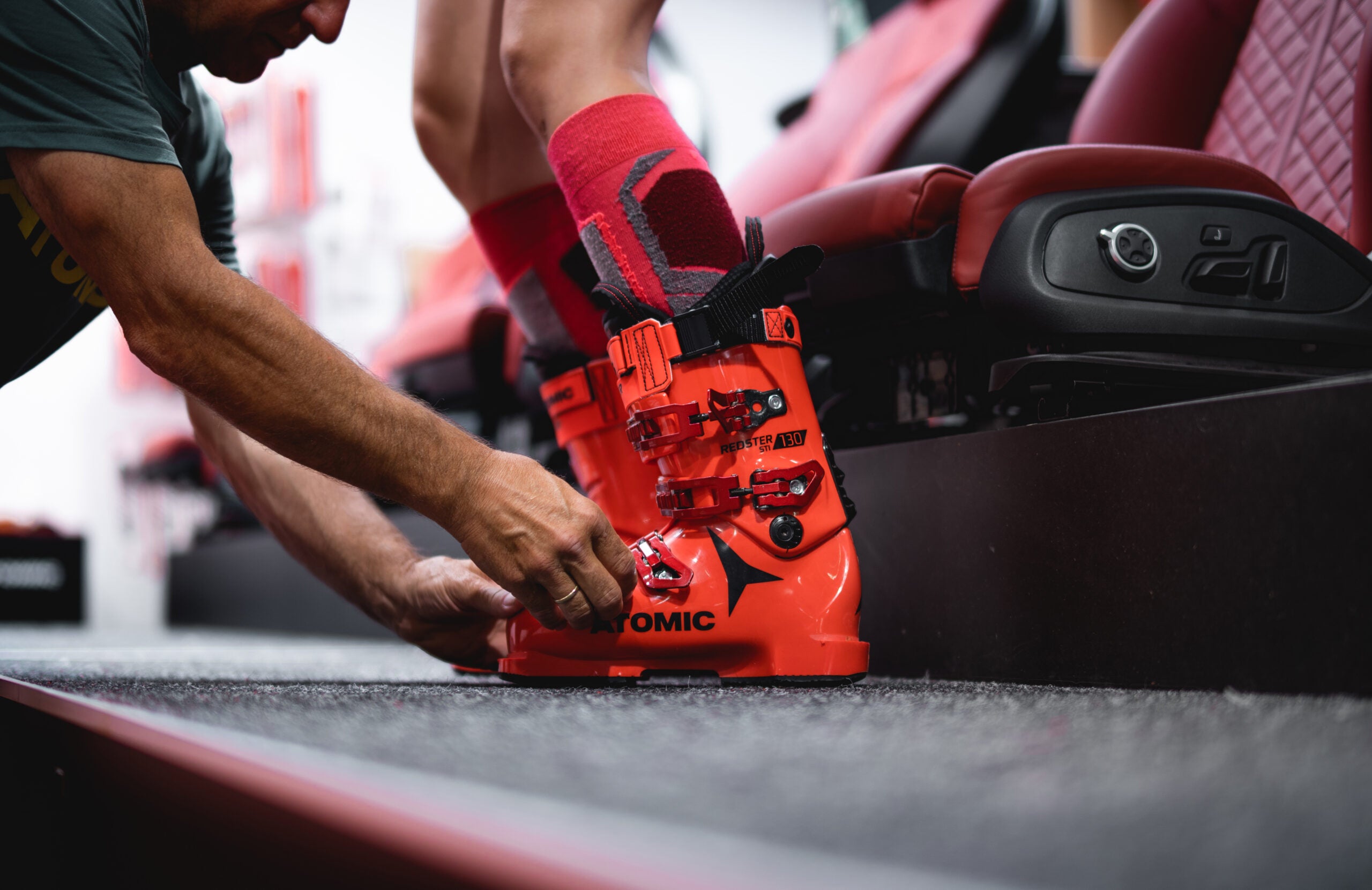
A bootfitter adjusts a pair of Atomic Redster 130 boots, the race-inspired model updated with the brand’s new Anatomic Toe Box for a more precise and comfortable fit. (Photo: Courtesy of Atomic)
Somewhere above the mid-station at Austria’s Flachau Ski Resort, just up the winding road from the Atomic factory, my boots—boots not made by Atomic—started to come apart. I’d been carving big GS turns all morning, fueling my delusion that I’m going to be a ski racer when I grow up. I was embracing gravity and the delicious edge pressure that comes from digging into perfect corduroy when something underfoot suddenly shifted. Two turns later, I looked down and saw the cuff separating from the lower shell. The pivot rivets—the pieces that act as the hinge between the cuff and the boot—had rattled out, meaning the entire upper of the boot had come loose from the base. Two turns later, I could see daylight between my cuff and shell. When I stopped, I realized that, somewhere along the way, three of my four rivets had rattled out of my boots where the cuff attaches to the base.

It was a fluke failure that could have been disastrous for both my body and my ski trip to Europe. But it’s how I ended up at Atomic’s factory in Altenmarkt that afternoon, standing in the Atomic boot lab with the design team, getting fitted into a pair of prototype Redster TX 130 boots. I was half expecting pain, humiliation, or both: the Redster has a reputation as a race boot built for people who make speed their profession. I am not one of those people.
But what I learned—and what I felt on snow over the remainder of the ski season—is that Atomic has been rethinking what power, fit, and most importantly, comfort should look like in its stiffest consumer-facing boot. That rethinking led them to make a seemingly small change to the Rester TX 130 that has made all the difference for how mere mortals experience a ski boot with this level of performance.
Inside the Factory Where the Redster Is Made
Atomic’s headquarters sits in the heart of Austrian ski country. Inside the nondescript building, the clean white walls of the product display rooms give way to the smell of warm plastic, the whine of milling machines, and rows of half-assembled prototype boot shells stacked along the wall. The design team, including boot product manager Matthew Manser, design manager Tristan Howle, and R&D manager Mario Baier, holds court in their offices here, at desks covered with CAD printouts, empty espresso cups, and early versions of would-be boot shells marked with Sharpie.
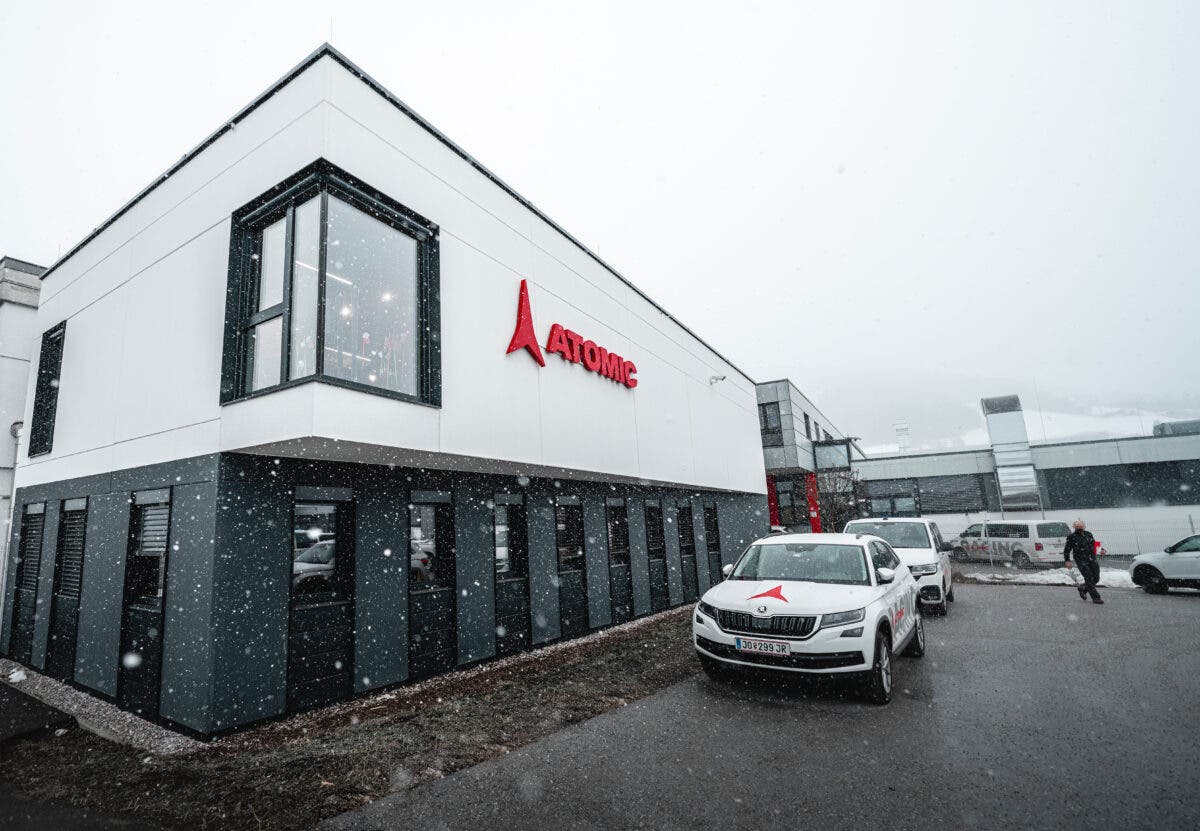
This is the nerve center for every Redster boot, including the consumer-focused Redster TX 130. Here, Atomic team racers like Mikaela Shiffrin and Breezy Johnson drop in between World Cup finishes to give their feedback on product development, which can be implemented immediately, and prototypes can go from lab to snow in a single day. “Everyone has different needs,” Manser told me during my visit. His job is to bring all that feedback together into an R&D brief—the genesis of every new ski boot design. Then comes the hard part: deciding what should change and what must stay the same—a delicate balance between preserving the old and iterating on the new.
ADVERTISEMENT
“When we make a new Redster boot,” he added, “we want to make it better, but also keep what’s working and not fuck it up.”
The Toe Box That Changed Everything
The Redster’s narrow 96 millimeter last is what sets it apart. It’s what makes the boot precise, aggressive, and powerful. In simple terms: the narrower the boot, the less your foot can move inside it—so every tiny shift of your ankle translates right to the ski. But over time, Manser and Howle kept hearing the same critique—not from elite racers with ballerina-caliber pain tolerance, but from instructors, ex-racers, and strong recreational skiers who live in their boots all day: the toe box was too rounded and too tight at the big toe.
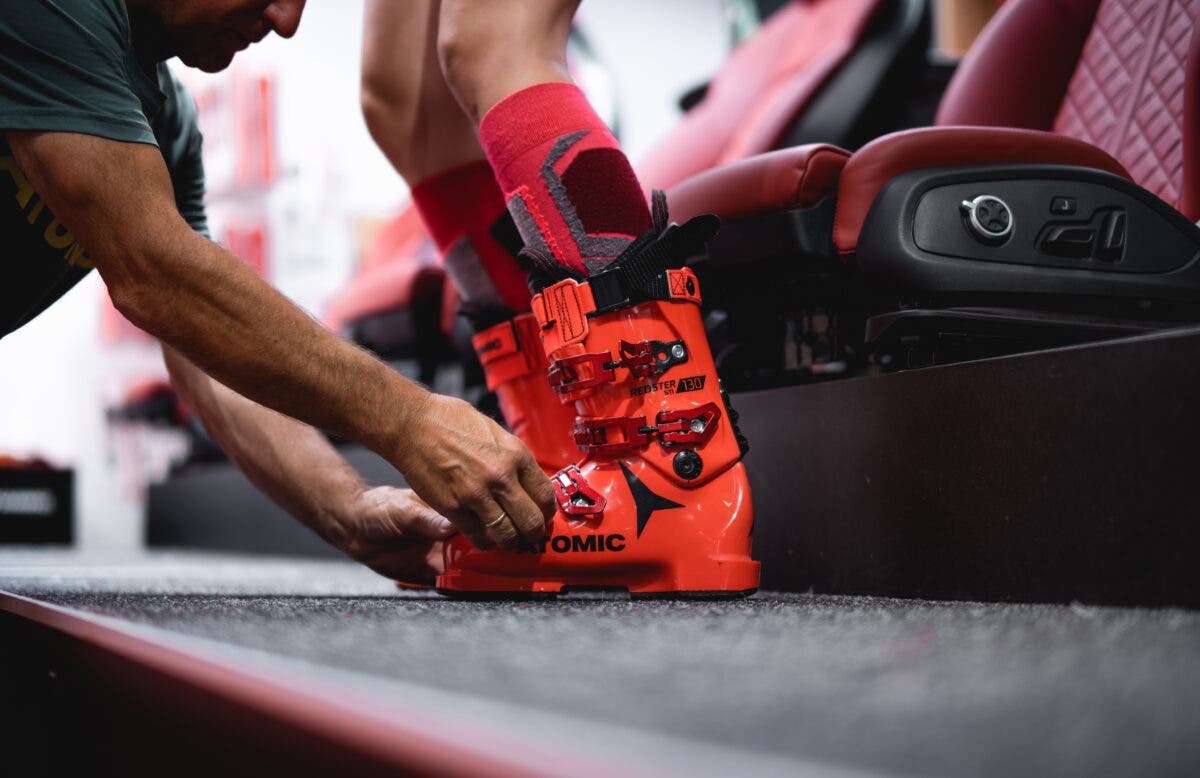
The new Anatomic Toe Box squares and flares subtly, where the big toe naturally sits. It adds just a few millimeters of space—but the psychological effect is immediate.
“When you change the silhouette, you change how skiers perceive fit,” Howle explained. “And perception is performance.”
The update sounds simple. It wasn’t.
ADVERTISEMENT
Atomic boots follow a roughly 34-month development cycle. Each mold costs roughly $1–$1.5 million USD, and every change cascades through liners, padding profiles, wall thickness, and fit charts. Baier walked me through the pipeline: 2-D engineering drawings become 3-D CAD models; software simulates molten plastic; the first shell is injected.
Then, Atomic’s development team takes the model to the snow to test for edge response, stiffness, and subtle changes in energy transfer. Atomic also brings in non-racers to get their feedback—a check against the pain tolerance of athletes who are used to suffering in tight boots in the name of performance.
Redster TX 130: Race DNA, Real-World Fit
The result is the Redster TX 130, the stiffest boot in the TX line and the clearest expression of Atomic’s “comfort without compromise” mission. It pairs the new Anatomic Toe Box with the Redster’s signature 96-millimeter last (no changes there) and plastics that maintain consistent flex even in the cold.
It’s still unmistakably a Redster—direct, supportive, unapologetically powerful—but now it’s one the rest of us can actually bear to ski in.
ADVERTISEMENT
What It Feels Like on Snow
When I slid into the prototypes later that afternoon, the difference was immediate. The support and stiffness were all there; so was the control that lets you pressure the tongue and drive a ski exactly where you want it. But the extra space at the big toe changed my stance and confidence. I stopped bracing. I stood more naturally. I skied better.
I wore them for the rest of my trip through Austria, Switzerland, and France without issue, and even more telling—perhaps the true test—I stayed in them through après at the Hofstadl. No regrets.
ADVERTISEMENT
A few millimeters doesn’t sound like much. But in Altenmarkt, it is enough to take a beloved race boot and turn it into something more skiers can live in—without losing what makes a Redster a Redster.
