Published March 20, 2023 09:13AM
The Key to Mikaela Shiffrin’s Historic Season? It’s Not What You Think.
Grief counseling, learning to accept disappointment, and channeling her self-doubt helped Mikaela Shiffrin achieve a season like no other.
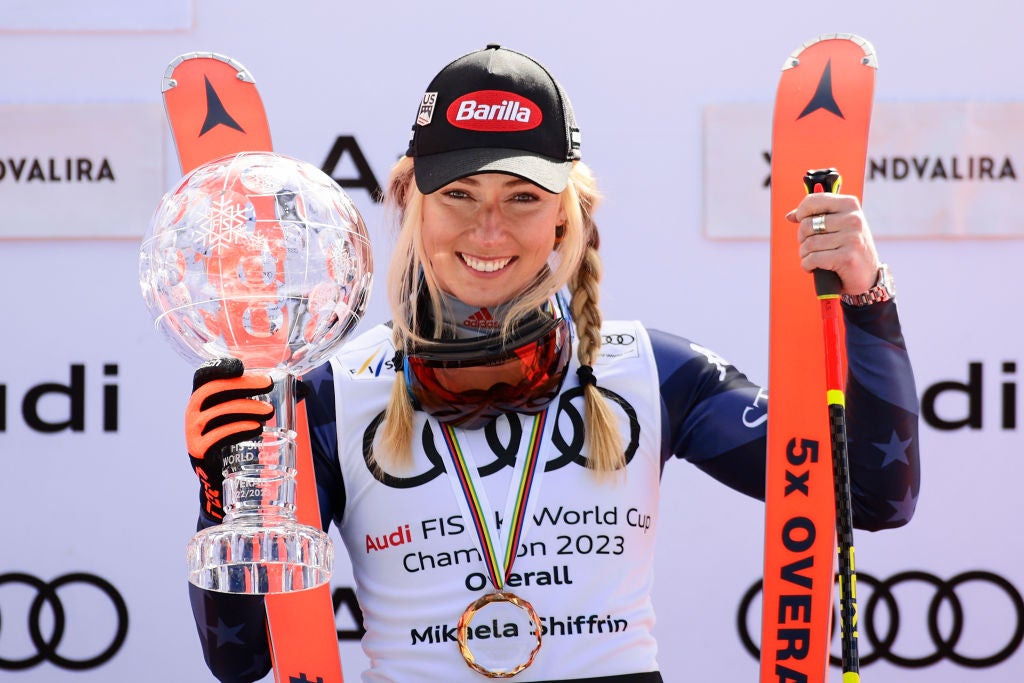
ANDORRA LA VELLA, ANDORRA - MARCH 19: Mikaela Shiffrin of the United States celebrates her Overall victory with the Overall Crystal Globe during the Audi FIS Alpine Ski World Cup Finals - Women's Giant Slalom on March 19, 2023 in Soldeu near Andorra la Vella, France. (Photo: Joan Cros Garcia - Corbis/Getty Images)
Few athletes have dominated their sports the way that Mikaela Shiffrin did this winter. Just a decade after winning her first World Cup race, Shiffrin broke more records than most ski fans knew existed.
This weekend at World Cup finals in spring-like Andorra, the 28-year-old phenom went out in style, winning Sunday’s giant slalom—her 14th win this season and record seventh in GS. The only alpine skiers (male or female) to record more than six giant slalom victories in a single season are Sweden’s Ingemar Stenmark (10 in 1978-’79) and Switzerland’s Marco Odermatt (seven this season).
As Shiffrin’s boyfriend Aleksander Aamodt Kilde said when interviewing her for TV after the GS in Andorra, “You’re just beating records on top of records, what’s next?”
Watch: Mikaela Shiffrin is interviewed by boyfriend Aleksander Aamodt Kilde
“Just keep moving right along,” she replied with one of her favorite expressions and the name of the YouTube video series she debuted this season.
Before “moving right along,” it’s worth looking back at what Shiffrin accomplished this season and more importantly, how she accomplished it:
- 88 World Cup wins—six more than Lindsey Vonn’s women’s record and two more than Stenmark’s record that held for 34 years. Shiffrin started the season at 74.
- 21 giant slalom wins—one better than Vreni Schneider’s women’s mark set in 1992.
- 14 World Cup wins—only Shiffrin herself (17 in 2018/19) and Schneider (14 in 1988/89) have won more in a single season.
- 138 podium finishes—a women’s record and one more than Vonn’s 137. Stenmark leads with 155 podiums in his 16-year-long World Cup career.
- 2,206 World Cup points tallied, surpassing the 2,204 she earned in 2019. Only Tina Maze has more (2,414 points in the 2012/2013 season).
- 31 World Cup races—two more than she ever raced before, plus four at world championships. In 2019, when she won 17 races and earned those 2,204 points, Shiffrin competed in 26 World Cup races and three at world champs.
- 5th overall World Cup title—the most by an American alpine skier.
- 7th World Cup slalom title—one behind both Stenmark and Vonn for the most discipline titles. Stenmark won eight in slalom and GS, Vonn eight in downhill.
- 2nd GS title—with her two GS titles and one in super-G (2019), Shiffrin has 10 smaller crystal globes—six behind both Stenmark and Vonn who hold 16 each.
- 14 world championship medals—At 2023 World Championships, Shiffrin added three more medals to her already-prodigious collection (gold in GS and two silvers, one in super-G, the other in slalom). With 14 world champs medals, she jumped to the top of the list for most won in the modern era — surpassing Norway’s Kjetil Andre Aamodt, who won 12 medals between 1991 and 2003. And Shiffrin climbed into a tie with four other skiing legends for most world championship golds won in individual events (7 and counting). Only Cristl Cranz from Germany has won more (12 golds and 15 total medals). The German dominated women’s alpine skiing back in the 1930s—considered the “before times” when fewer women competed.
And to think Shiffrin started the season wondering if she would ever win another slalom globe. After a lull in late November and December—between her opening slalom wins in Levi and the dominant skiing of the past three months—Shiffrin became a new, faster version of her already fast self.
ADVERTISEMENT
Watch: Mikaela Shiffrin wins final GS of the season to collect win #88
“My highest level of skiing has been higher than the previous couple seasons, maybe higher than my whole career,” Shiffrin acknowledged in a press conference. “My average level of skiing has also been higher than previous seasons and my lowest level of skiing has also been higher. So it’s like raising the bar on all levels, and that’s something I’m proud of.”
So what led to what we might call Shiffrin 2.0?
Shiffrin, of course, thanked her team, with a callout to Mike Day, her long-time coach who left suddenly during world championships last month when he learned that Shiffrin wanted to take her team in a new direction, hiring a female coach to highlight women in a male dominated sport.
Related: Shiffrin unexpectedly parts with with longtime head coach
“[Mike] is as much a part of the success this entire season as he’s ever been and I’m incredibly thankful to everything that he’s done for me and my entire career,” Shiffrin stated.
The main difference in Shiffrin’s skiing required work that started last summer—work that didn’t just take place in the gym. Since her father tragically died in February 2020, Shiffrin has struggled with grief. As she began racing again after his death in 2021 and 2022, she found that she could not remember courses, especially second runs.
“A lot of people were saying, ‘What’s wrong with her? She’s choking on all of her second runs,’” acknowledged Shiffrin. “I was like, I know, I don’t understand what’s wrong with me. I feel like I can’t remember anything, and I lose all of my energy and motivation.”
Until she began working with a psychologist last summer, she did not understand that she was dealing with trauma.
And it will continue to have an impact for the rest of her life. But grief counseling helped. When the 2022-2023 season began with two slaloms in Levi, Finland, Shiffrin had a “weird a-ha moment.” She remembered the whole course, and she could ski more freely. It was like coming out of a cloud.
“It’s not perfect every single day, for sure,” she added. “But that was one thing that changed a bit for me this season.”
The other piece of the puzzle: Shiffrin has learned to better accept disappointment.
While on the race course it might appear that things go Shiffrin’s way, she has come to realize that in life, that’s not always the case. Life, she now knows, requires a fight.
“It’s not just me, everybody in the room can probably relate to that,” she said. “It’s kind of a struggle most days. We’re all just riding the struggle bus.”
Rather than focus on the records that everyone was talking about, Shiffrin set goals for the season: reclaim the overall title and maybe, hopefully, the slalom and/or GS titles, too.
“What I haven’t been afraid of is the disappointment that will come if I didn’t achieve them, whether it’s 87 or the overall or the globes, any of the globes,” she said. “You’re going to have disappointing days. I know it’s going to happen. I don’t want it to happen, it’s not comfortable. But I’m not afraid of it anymore.”
Shiffrin also acknowledged that she is driven by self-doubt. It’s a dichotomy in sports that should be examined more closely—because self-doubt, like struggling through life, is a human condition, particularly for women.
An introvert who freely admits that she is socially awkward, Shiffrin has never described herself as a confident person.
“I’m not the person who walks into a room feeling like I own it,” she admitted. “Normally if I walk into a room full of people, I want to run in the other direction.”
She has learned to use self-doubt as a guide—to accept it rather than push it aside.
“If you have fear, it’s trying to say, ‘This is something you should respect, maybe this is something you can address, this is something you can work on and get better for next time,’” she explained.
“Being doubtful at the start of a World Cup run has never done anything bad for me,” she added. “In fact, it’s actually only been helpful because I’m thinking about the right things. I’m not sure if I can do it, but I know that I want to try. That’s where I’m in my zone and have my best performances.”
As for what the future holds, Shiffrin will be back next season—perhaps even as Shiffrin 3.0.
ADVERTISEMENT
More Mikaela Shiffrin News
It’s official: Mikaela Shiffrin just became the best ski racer of all time
Mikaela Shiffrin disqualified in first race of World Championships
Shiffrin ties Lindsey Vonn’s record with win in Slovenia